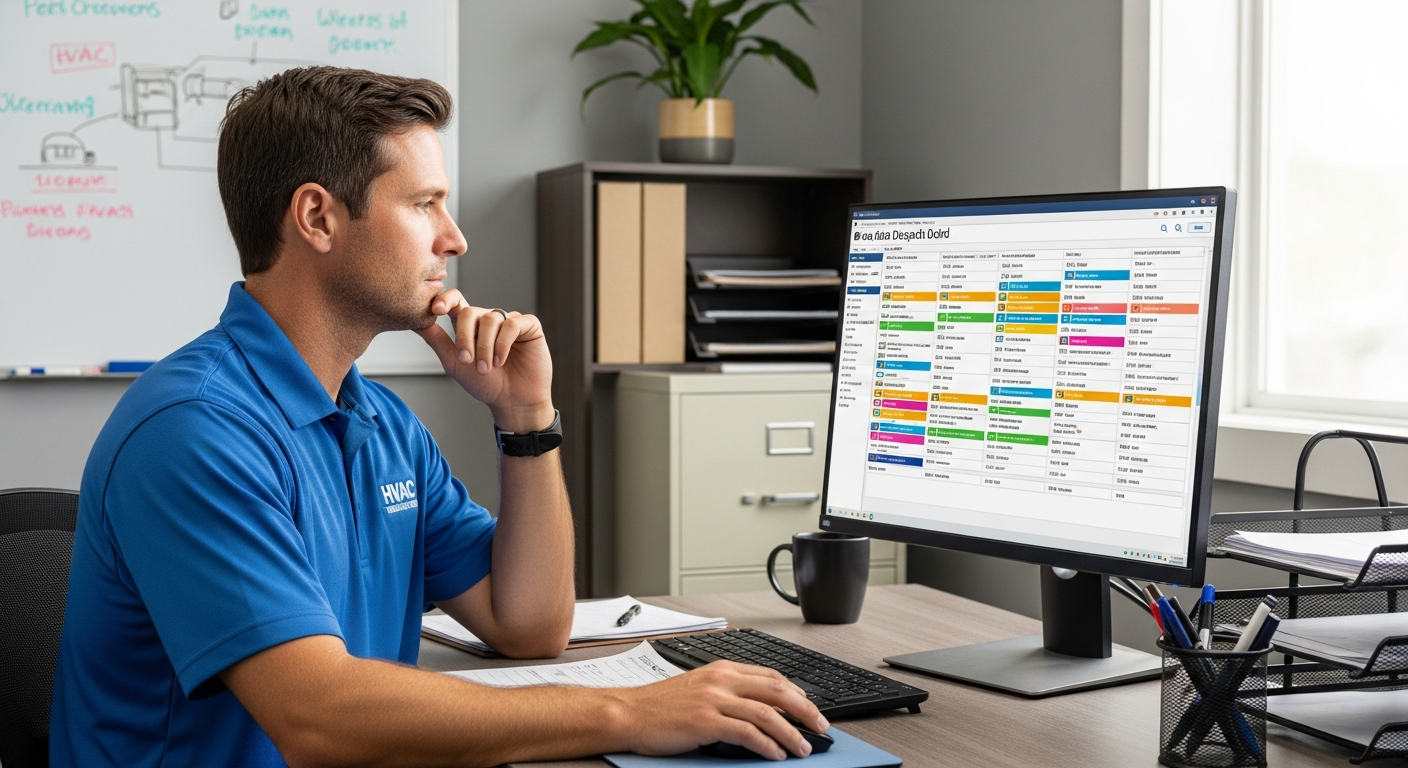
You started as a one-truck operation and handled your own schedule. Now you have 2-3 techs and scheduling is eating your life. The whiteboard is covered in crossed-out names. Your phone rings all day with customers, techs, and suppliers. You're dispatching from your truck between jobs.
Sound familiar? Here's how to manage dispatch for a small crew without hiring a full-time dispatcher.
The 3-Tech Scheduling Problem
At 1 truck, scheduling is simple — you know where you are and what's next. At 3 trucks, complexity doesn't triple — it explodes:
- 3 techs × 4-6 jobs each = 12-18 daily scheduling decisions
- Each decision involves: skill match, location, drive time, parts availability, customer preference
- One cancellation or emergency creates a cascade of changes
- Every tech calls you for the same question: "What's next?"
This is the stage where most HVAC companies either grow or stall. The ones that grow are the ones that fix dispatch.
Strategy 1: Time-Block Your Schedule
Stop scheduling individual jobs and start scheduling blocks:
| Block | Time | Type |
|---|---|---|
| Morning | 8:00 - 12:00 | Scheduled maintenance + tune-ups |
| Midday | 12:00 - 1:00 | Lunch + drive to afternoon area |
| Afternoon | 1:00 - 5:00 | Service calls + repairs |
| Emergency | Reserved slot | 1 open slot per tech for same-day emergencies |
Time-blocking works because:
- Maintenance calls are predictable — schedule them in the morning
- Service calls are reactive — stack them in the afternoon
- Emergency slots prevent blowing up your whole schedule for one urgent call
Strategy 2: Zone Your Service Area
Divide your service area into 3-4 zones. Assign each tech to a zone for the day. This alone can save 30-60 minutes of drive time per tech per day.
Example for a metro area:
- Tech A: North zone (morning), Central zone (afternoon)
- Tech B: East zone (morning), South zone (afternoon)
- Tech C: West zone (all day — longer drives, fewer jobs)
Don't let customer requests override zones. "Can you send someone today?" — yes, but they get the tech assigned to their zone, not whoever is closest right now.
Strategy 3: Morning Dispatch, Not Real-Time Dispatch
The biggest time-killer is real-time dispatching — changing assignments throughout the day based on who finishes first. This feels efficient but creates chaos.
Instead:
- Night before: Set tomorrow's schedule. Assign every known job to a tech.
- 7:00 AM: Review the schedule. Handle any overnight cancellations or additions.
- 7:30 AM: Release the schedule to techs. They see their full day on their phone.
- During the day: Only adjust for true emergencies — not "I finished early."
Techs who finish early can knock out callbacks, equipment inspections, or head to the next job. Don't re-dispatch them unless there's an actual emergency.
Strategy 4: Let Techs Self-Serve Information
Every time a tech calls the office with a question, that's a 3-5 minute disruption. Common questions:
- "What's the customer's address?"
- "What equipment do they have?"
- "What was done last time?"
- "What's the gate code?"
If this information is in a digital system that techs can access on their phone, those calls stop. That's 10-15 calls per day × 3 minutes = 30-45 minutes of your day back.
Strategy 5: Use a Real Dispatch Tool
A whiteboard works for 1 truck. A spreadsheet works for 2. At 3 trucks, you need a digital dispatch board.
What it should do:
- Show all techs and jobs in one view
- Drag and drop to reassign jobs
- Auto-notify techs when their schedule changes
- Track job status (en route, on-site, complete) without phone calls
- Work offline for techs in basements and dead zones
This isn't about fancy software. It's about eliminating the 50+ daily micro-decisions that eat your time and create mistakes.
The Real Cost of Bad Dispatch
Bad dispatching costs more than time:
- Lost revenue: A tech sitting idle for 30 minutes = $50-75 in lost billings
- Fuel waste: Criss-crossing the service area adds $15-25/day per truck in fuel
- Customer frustration: "Your window was 8-12 but the tech showed up at 3"
- Tech burnout: Nobody likes driving in circles or sitting in parking lots
For a 3-tech operation, fixing dispatch can recover $500-1,000/week in lost productivity. That's $25,000-50,000/year.
Getting Started
You don't need to implement everything at once:
- This week: Zone your service area and assign techs to zones
- Next week: Start time-blocking morning maintenance vs afternoon service calls
- This month: Move from whiteboard to a digital dispatch tool
- Ongoing: Track drive time, idle time, and jobs per tech to find bottlenecks
ServiceTap's dispatch board is built for exactly this stage — 2-5 techs, no full-time dispatcher, and an owner who's still in the field. Start free and see if it saves you the 30+ minutes a day it saves most shops.